Software-Defined Everything: The Foundation of the AI-powered Digital Enterprise
Industry today is not facing a single technological change but a structural transformation. Markets are evolving faster than production systems, product life cycles are shortening, while industrial assets are designed to last for decades. At the same time, complexity along the entire value chain is increasing – technologically, organizationally, and regulatory. In this reality, adaptability becomes the decisive capability to secure and sustainably develop industrial value creation.
Within this context, classical automation reaches its structural limits. Automation based on fixed sequences, static logics, and extensive manual engineering can no longer keep up with the pace of modern industry. Efficiency gains within this paradigm are insufficient when products, processes, and frameworks are constantly changing – and they do not provide a sustainable foundation for the widespread use of artificial intelligence.
What is needed now is the next evolutionary step: the automation of automation itself. Instead of specifying every process in detail, industrial systems must be empowered to solve tasks autonomously – based on objectives, context, and continuous learning. Software-Defined Everything (SDx) becomes the necessary organizing principle: it decouples functionality from specific hardware, creates a continuous, lifecycle-spanning data foundation, and enables systems to self-configure, adapt, and optimize.
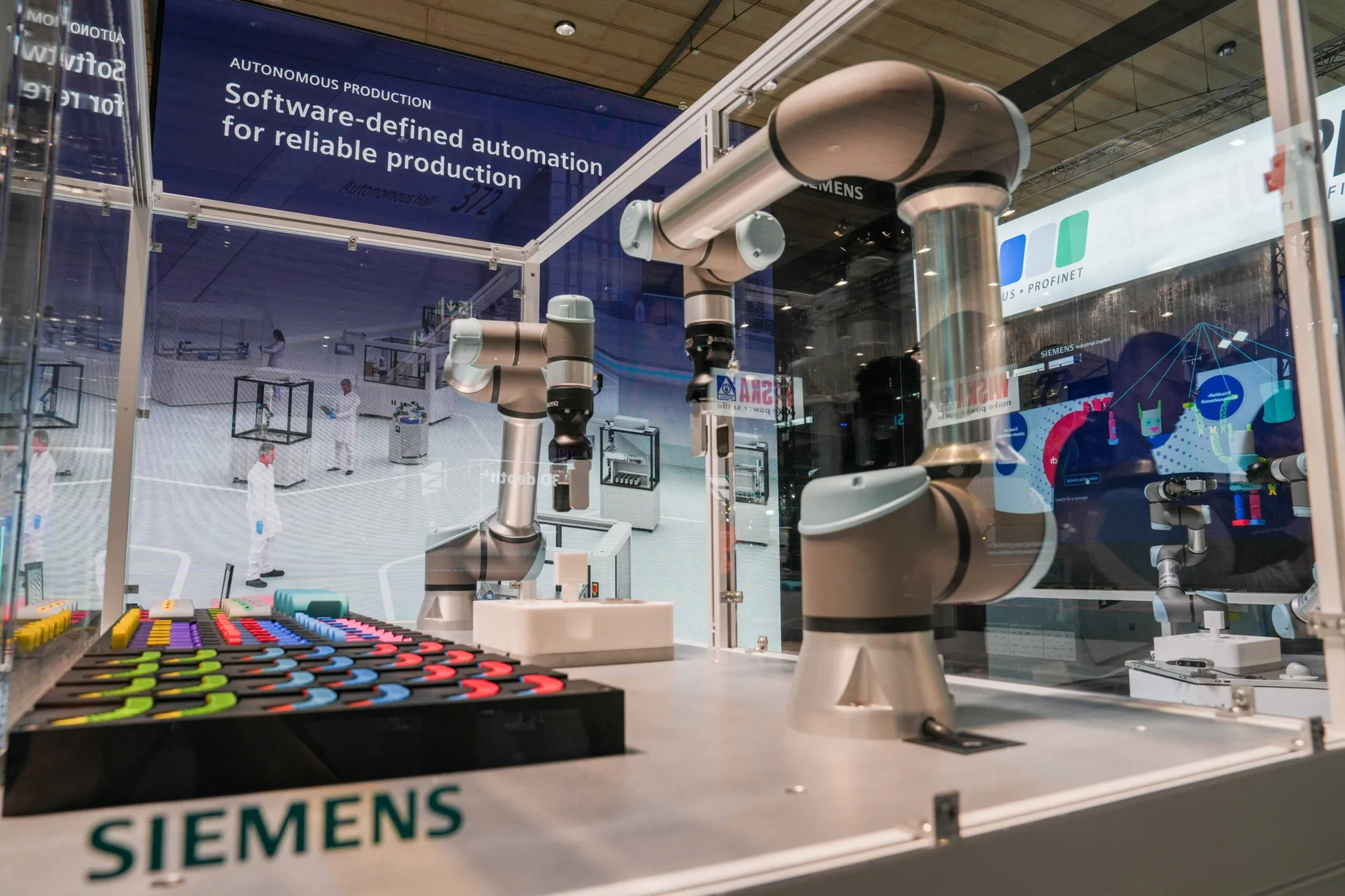
In production, this approach manifests as Software-Defined Automation (SDA). SDA is the consistent application of Software-Defined Everything to the production automation layer. Control logic, functionality, and intelligence are decoupled from physical hardware, software-defined, and continuously developed. Hardware remains the stable, high-performance foundation, while software provides flexibility, adaptability, and learning capability to production systems.
This creates the structural basis for the AI-powered Digital Enterprise: an industrial organization in which software, digital twins, and industrial AI work in closed-loop cycles, systems learn continuously, and decisions are not only prepared but also operationally executed. From this capability, the path to the Industrial Metaverse opens up – as the next stage of development, where planning, simulation, collaboration, and operational control converge in a shared digital space, supporting real industrial value creation in real time.